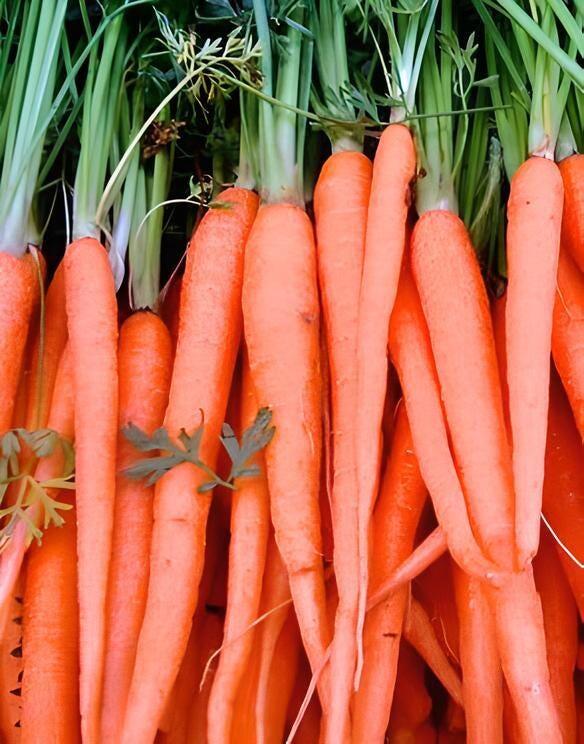
Tendersweet Carrot Seeds — Heirloom | Century-Old American Classic, 9–10 Inch Coreless Roots, Unmatched Sugar Content | 70–75 Days
Tendersweet (Daucus carota subsp. sativus) is aptly named — a century-old American heirloom with 9–10 inch tapered, coreless roots and sugar content second only to the sugar beet among root vegetables. Rich orange color, crisp and tender flesh, and a sweetness that is just as delicious raw as when cooked. Tendersweet has served as the parent crop to countless hybrids, passing on its legendary sweetness to generations of commercial varieties — yet the original open-pollinated heirloom remains unsurpassed for flavor. Perfect for canning, juicing, or eating raw. 1g / ~700+ seeds per packet. 70–75 days to maturity.
-
Botanical name: Daucus carota subsp. sativus
-
Days to maturity: 70–75 days
-
Days to germination: 14–21 days
-
Root size: 9–10 inches long; 2 inches at the shoulder; uniformly tapered to semi-blunt end
-
Root color: Rich orange throughout
-
Core: Coreless — indistinct core, consistent flavor throughout
-
Flavor: Unmatched sweetness — sugar content second only to sugar beet
-
Soil: Loose, loamy, composted, well-drained; pH 6.0–7.0
-
Temperature: 55–75°F
-
Plant height: 6–18 inches; rows 18–24 inches
-
Packet size: 1g / ~600+ seeds
-
Sowing depth: ½ inch
-
Spacing: Thin to 2–4 inches; 16 plants per sq ft
-
Light: Full sun
-
USDA Zones: 3–10
-
Type: Heirloom, open-pollinated, non-GMO, annual
A Century of Sweetness — What the Old Catalogs Said
Tendersweet’s reputation for exceptional sweetness is not a modern marketing claim — it is documented in seed catalogs going back nearly a century:
“Very sweet and nearly coreless, of good shape; cylindrical, very smooth and about 6 inches long. Of deep orange-red color; crisp, tender and of very fine flavor. Tendersweet carrot is a fine home garden sort, excellent for early market use.”
— Isbell’s Seed Company Catalog, 1935
“Tendersweet carrot is one of the finest varieties, always sweet, tender and brittle, the roots are from 7 to 8½ inches long, 2 inches in diameter at the shoulder and uniformly tapered to a semi-blunt end. The flesh of this carrot is rich orange with indistinct core.”
— Oscar H. Will Pure Seed Book, 1940
Over 80 years later, the description holds. Tendersweet remains one of the finest-flavored heirloom carrots available — and the parent crop to countless commercial hybrids that have tried to replicate its sweetness.
The Parent of Countless Hybrids
Tendersweet’s exceptional sugar content and coreless root structure made it the go-to parent variety for commercial carrot breeding programs throughout the 20th century. Countless hybrid varieties trace their sweetness back to Tendersweet genetics. Growing the original open-pollinated heirloom means growing the source — the variety that defined what a sweet carrot could be, before hybridization optimized for yield and shelf life at the expense of flavor.
In the Kitchen
-
Raw eating: The standout use — the sugar content is immediately apparent fresh from the garden; sweet, crisp, and satisfying with no bitterness
-
Juicing: The high sugar content produces an exceptionally rich, sweet carrot juice; the flavor is noticeably superior to standard orange varieties
-
Canning: Coreless roots hold texture and color through pressure canning; follow USDA guidelines for carrots
-
Roasting: Halve lengthwise and roast at 400°F with olive oil and thyme; the high sugar content caramelizes beautifully
-
Glazed carrots: The natural sweetness requires minimal added sugar; a simple butter and honey glaze is all that’s needed
-
Victory Garden cooking: A classic American heirloom with a century of home kitchen history — soups, stews, roasts, and preserves
Growing Notes
Cool weather crop — direct sow 2–3 weeks before final spring frost and every 2 weeks after for successive harvests. Sow ½ inch deep, 1–2 inches apart in loamy, loose, well-drained soil (pH 6.0–7.0) in full sun. Thin to 2–4 inches as true leaves establish. Carrots require a deep, well-tilled garden for straight taproot growth — loosen soil to at least 10–12 inches. Avoid nitrogen-rich fertilizers, which cause root abnormalities and excessive greens. Keep soil consistently moist. Harvest at 70–75 days when roots show at the soil surface — use a hori-hori or garden fork in firmer soils.
Frequently Asked Questions
Is Tendersweet really sweeter than other carrots?
Yes — Tendersweet’s sugar content is second only to the sugar beet among root vegetables, making it one of the sweetest carrots available. The sweetness is immediately apparent when eaten raw and concentrates further with cooking. This is the variety that commercial breeders used as a parent for generations of hybrid carrots specifically because of its exceptional sugar content.
What does “coreless” mean for Tendersweet?
Tendersweet has an indistinct core — the xylem tissue at the center is so similar in color and texture to the surrounding flesh that it is nearly invisible. This means consistent flavor, texture, and color from skin to center, with no tough pale center to detract from eating quality.
Is Tendersweet good for the Victory Garden?
Yes — Tendersweet has been a Victory Garden staple since World War II. Its exceptional flavor, reliable production, and versatility in the kitchen (raw, canned, juiced, roasted) made it one of the most recommended home garden carrot varieties of the era. Growing it today connects your garden to a century of American home food production.
Packed and shipped by Box Garden Seeds LLC — heirloom seeds grown without GMOs, selected for flavor, resilience, and your garden’s success.